Case study
Soho: Leading the evolution from search to matching to AI
- Role progression
- Product Designer → Lead Product Designer → Head of Product
- My focus
- Product strategy, UX/UI design, Team leadership, Product delivery and AI-assisted development
- Platforms
- Web, iOS and Android
- Period
- 2018–2026
Product strategy
The real estate marketplace growth loop
Soho started as a free-to-list alternative to traditional property portals. Removing listing fees lowered the barrier for agents, but that was only the starting point.
Growing the marketplace meant strengthening both sides together: enough properties to attract buyers and renters and enough demand to give agents a reason to participate. Our product strategy focused on reinforcing this cycle through better discovery, valuable leads and opportunities for monetisation.
More listings
More choice for visitors
Soho marketplace
More agents
More inventory and monetisation opportunities
More visitors
More demand signals and potential leads
Impact at a glance
- 3.8×
- Monthly recorded listing interactions
- 2×
- Monthly leads sent to agents
- 2M+
- Annual unique visitors to the platform at its peak
Chapter 01 · PropertyMatch
Beyond search: Introducing PropertyMatch
A more personalised way to discover homes, where every interaction helps shape better recommendations and reveals what buyers and renters actually want.
Context
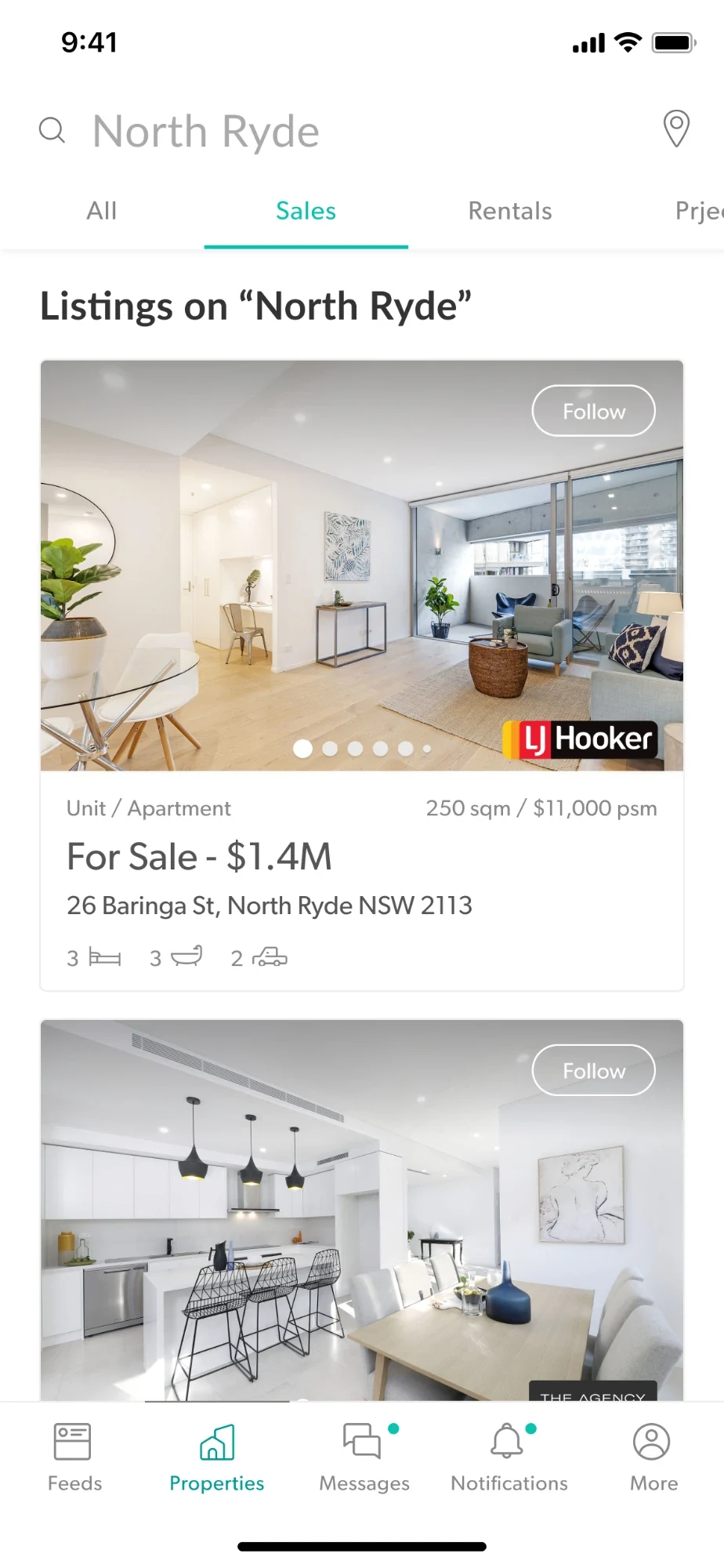
Traditional property search was largely the same across portals: filters, long lists of results and limited signals of user interest beyond enquiries and bookmarks.
Competing with established players like realestate.com.au and Domain on traffic or enquiry volume alone wasn’t realistic for Soho. We needed a clear point of difference that could attract property seekers while creating more value from the audience we already had.
The product bet
What if we could make property discovery easier and more engaging, while turning everyday interactions into meaningful signals of buyer and renter intent?
Early explorations
We initially explored ways to make property demand and buyer interest more visible, borrowing ideas from e-commerce to create urgency and encourage engagement.
Low
The demand indicator
A proposed demand score to help property seekers understand how much interest a listing was attracting.
The interest meter
A visual indicator showing buyer attention building around a property, encouraging users to take action.
Why we moved on
The problem wasn’t displaying the data. It was collecting it.
Both concepts had a fundamental limitation: we didn’t have enough meaningful interactions to generate reliable demand or interest scores. There was also a concern that low-demand ratings could discourage agents from listing with us.
Rather than trying to visualise data we couldn’t confidently support, we needed to find a more engaging way for property seekers to express their preferences and generate those signals in the first place.
Solution
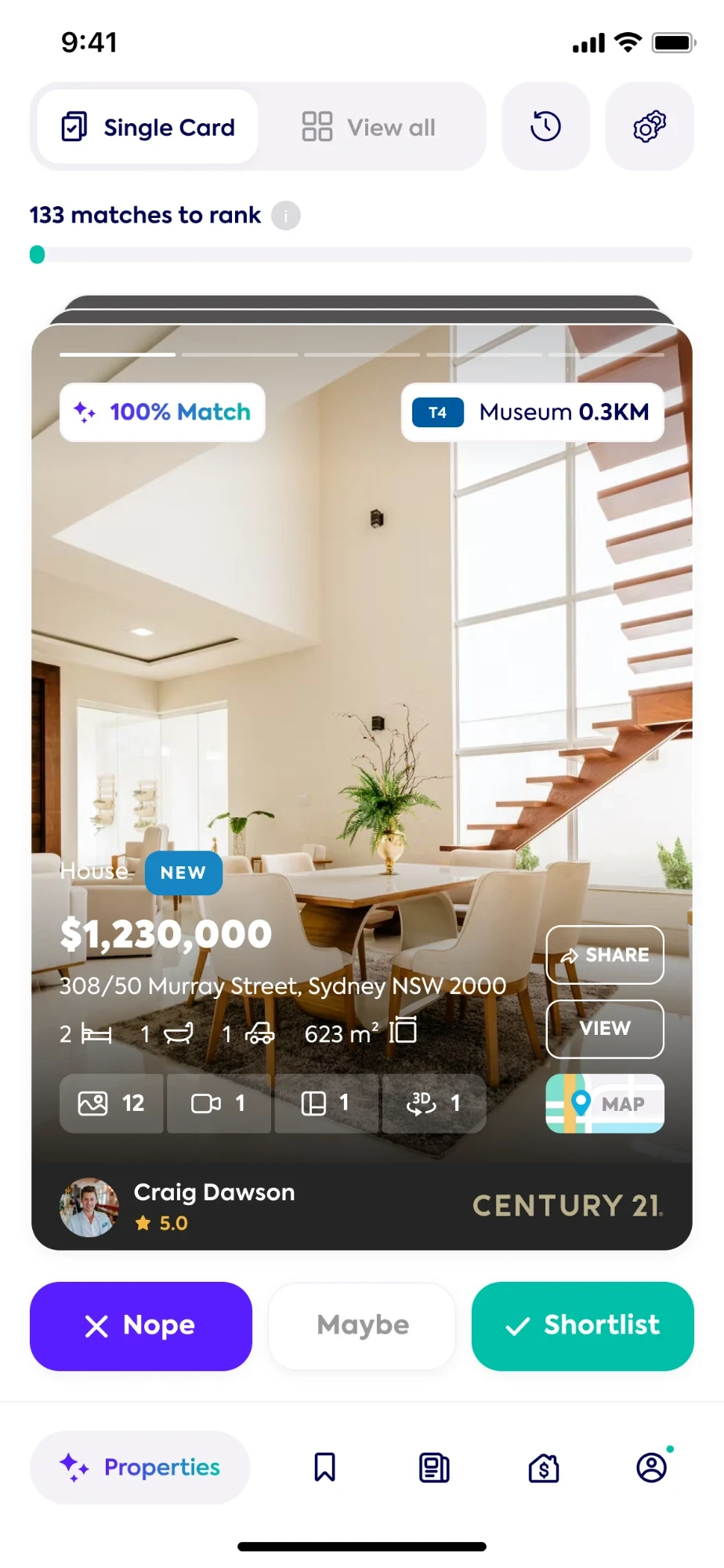
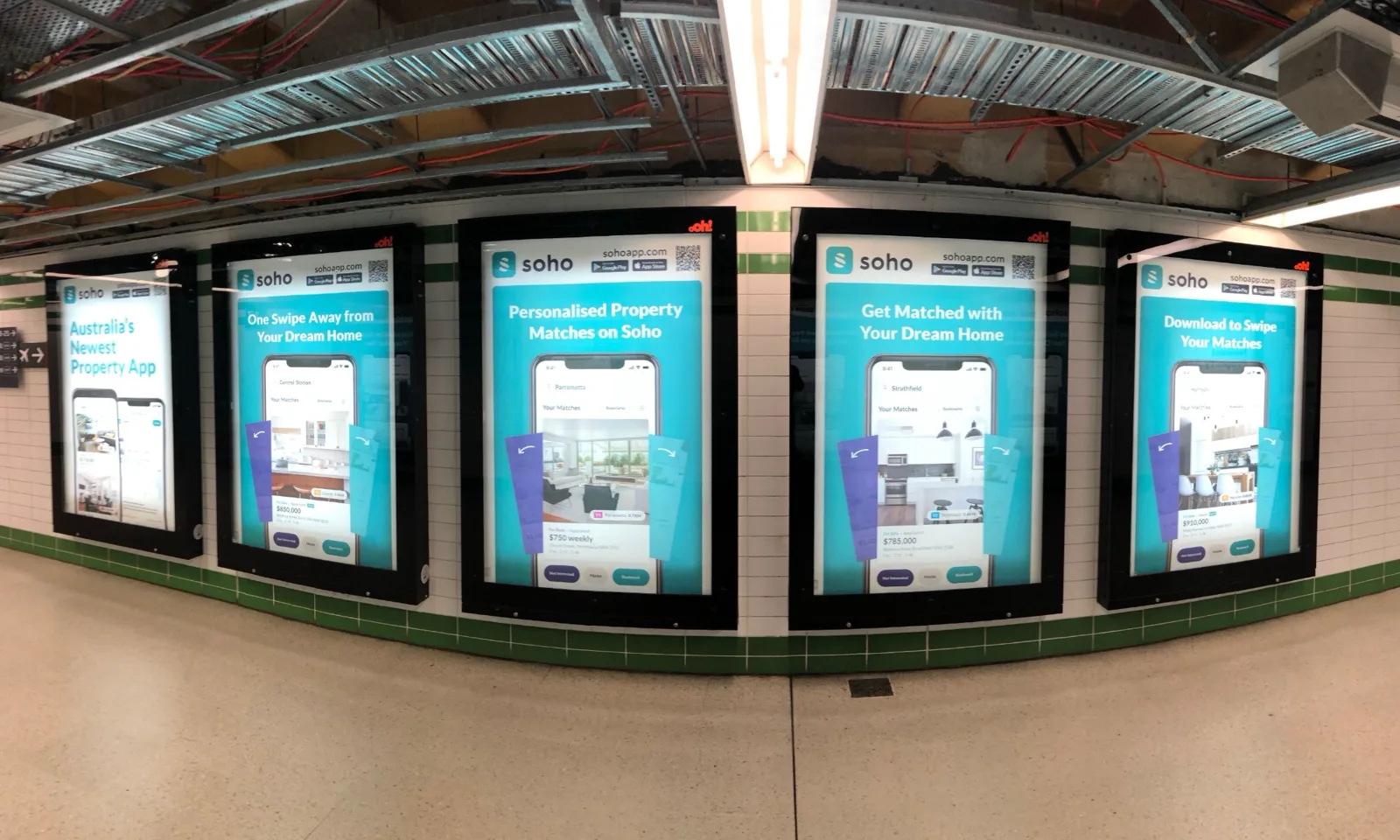
Inspired by Tinder’s swipe mechanic, we introduced PropertyMatch: a more interactive way to discover homes, one property at a time.
Instead of relying mainly on page views, bookmarks and enquiries, users could express their preferences through simple actions: Nope, Maybe and Interested.
Combined with their Match Profile, these interactions gave us richer signals about what buyers and renters were looking for. They also created a foundation for personalised recommendations and a better understanding of property demand.
Before PropertyMatch
- Enquire
- Bookmark
Limited visibility into preferences before an enquiry
With PropertyMatch
- Nope
- Maybe
- Interested
Explicit preference signals from everyday browsing
Expanded over time
- Book Inspection
- Request Inspection
Typical listing interaction breakdown
- 70%
- Nope
- 20%
- Maybe
- 10%
- Interested
Traditional search vs PropertyMatch
My contribution
I helped drive the product shift towards personalised matching and led the UX design of the property cards, swipe interactions and decision states.
I also worked closely with our engineering lead on what the matching logic needed to read from each interaction, collaborating with our developers to launch the first version in approximately three weeks.
Outcome
Without significant growth in our user base or listing inventory, PropertyMatch helped increase monthly recorded listing interactions from approximately 790,000 to over 3 million (3.8×).
This allowed us to capture richer signals of buyer and renter intent from the audience we already had, rather than relying on traffic growth alone.
Product in action
Experience PropertyMatch
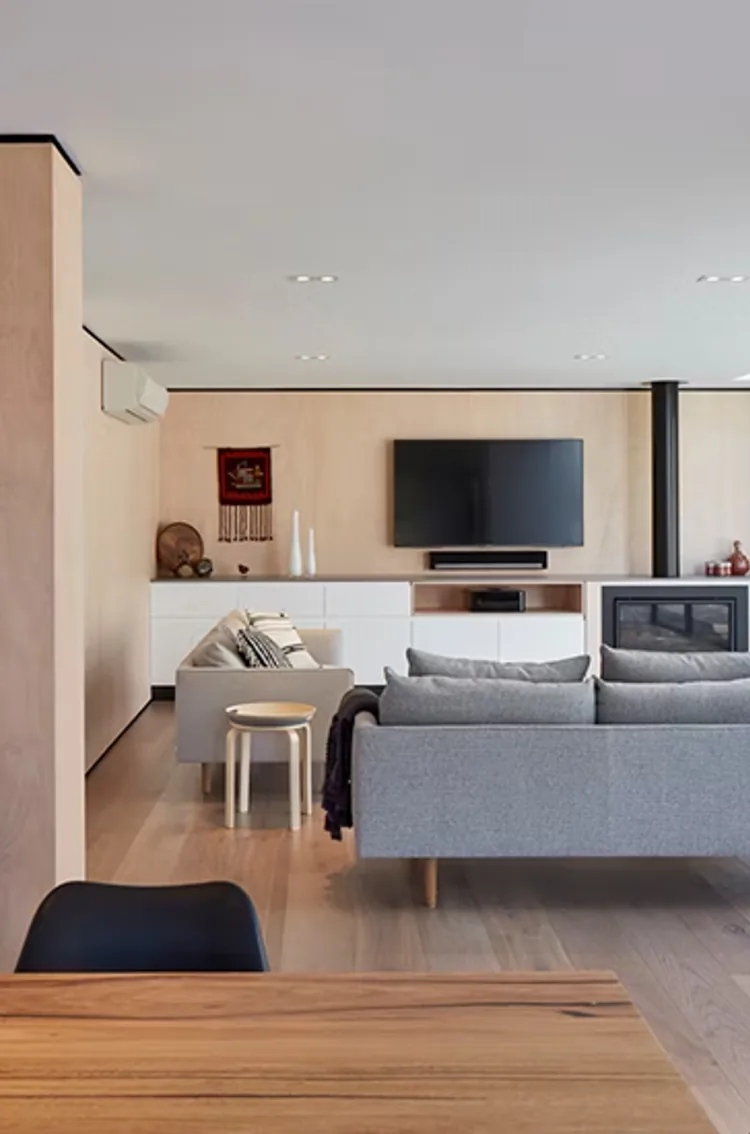
Try a simplified version of PropertyMatch. Swipe or tap Nope, Maybe or Interested to explore the next home.







What came next
PropertyMatch allowed us to better understand what property seekers wanted. The next challenge was turning those insights into products and services that agents would find valuable.
Chapter 02 · Agent Products
Beyond free listings: Building products for agents
We wanted to give agents more than just a place to list properties for free. From finding new customers to promoting listings and understanding their market, our goal was to build tools that could genuinely help them grow their business.
Context
Free listings helped Soho attract agents, but we needed other ways to generate revenue. The challenge was building products that delivered enough value for agents to want to pay for them.
Over the years, we explored different approaches, from a LinkedIn-style network for real estate to lead generation, marketing tools and market intelligence. Some products launched, others were shelved early, while some remained prototypes.
To decide where to invest our time and resources, I evaluated opportunities based on two considerations: their monetisation potential and their potential to drive user engagement.
How I evaluated product opportunities
- SohoAI (Launched): high on “monetisation potential”, high on “user engagement potential”.
- Agent Portal (Launched): high on “monetisation potential”, high on “user engagement potential”.
- Livecast (Launched · Shelved Early): high on “monetisation potential”, high on “user engagement potential”.
- AI PropReels (Launched): high on “monetisation potential”, low on “user engagement potential”.
- ListingRadar (Concept / Prototype): high on “monetisation potential”, low on “user engagement potential”.
- Connect Pro (Launched · Shelved Early): high on “monetisation potential”, low on “user engagement potential”.
- App Marketplace (Launched · Shelved Early): high on “monetisation potential”, low on “user engagement potential”.
- Social Ads (Concept / Prototype): low on “monetisation potential”, low on “user engagement potential”.
- Listing Report (Concept / Prototype): low on “monetisation potential”, low on “user engagement potential”.
- Inspection & Appraisal Lead Gen (Launched): low on “monetisation potential”, high on “user engagement potential”.
Solution
Rather than focusing on a single product, we explored different ways to help agents find customers, manage their business and make better use of Soho's data.
- Finding new customers
- Early experiments included Connect Pro, a LinkedIn-style network where agents could discover potential buyers based on their budgets and property interests. We also introduced Book Inspection and Request Inspection alongside Enquire, plus appraisal requests to connect property owners with agents.
- Managing and promoting listings
- We launched the Agent Portal, bringing together agent and agency profiles, listing management and marketing tools. We also introduced AI PropReels and experimented with an app marketplace, while exploring social advertising tools to help agents promote their properties.
- Turning data into insights
- We prototyped ListingRadar and Listing Reports, exploring how agents could monitor competing properties, understand buyer interest and track listing performance. These concepts showed how our property data could become valuable services beyond free listings.
My contribution
I owned the agent-product roadmap and worked closely with the CEO to develop and present our annual product strategy. A key consideration was finding ways to monetise the platform without compromising the experience for property seekers, our primary audience.
I led the UX design of the Agent Portal, inspection and appraisal flows and other agent-focused experiences. Working with our frontend and mobile developers, I helped bring selected products from concept through launch.
When shipping more products wasn’t translating into the commercial results we hoped for, I helped shift our focus towards developing, marketing and selling products that agents would genuinely find valuable.
Outcome
- 2×
- Monthly leads sent to agents
Following the introduction of Book Inspection and Request Inspection alongside Enquire, monthly leads sent to agents doubled, creating more opportunities from our existing audience.
- 44
- Agent Portal subscribers
By May 2025, the Agent Portal had reached 44 subscribers, marking an early milestone in building a subscription-based offering for agents.
Not every experiment gained traction, but the experience helped us better understand the challenges of monetisation and where to focus our efforts.
Product in action
A closer look at some of the agent products we launched and concepts we explored.
Connect Pro buyer discovery, image 1 of 1
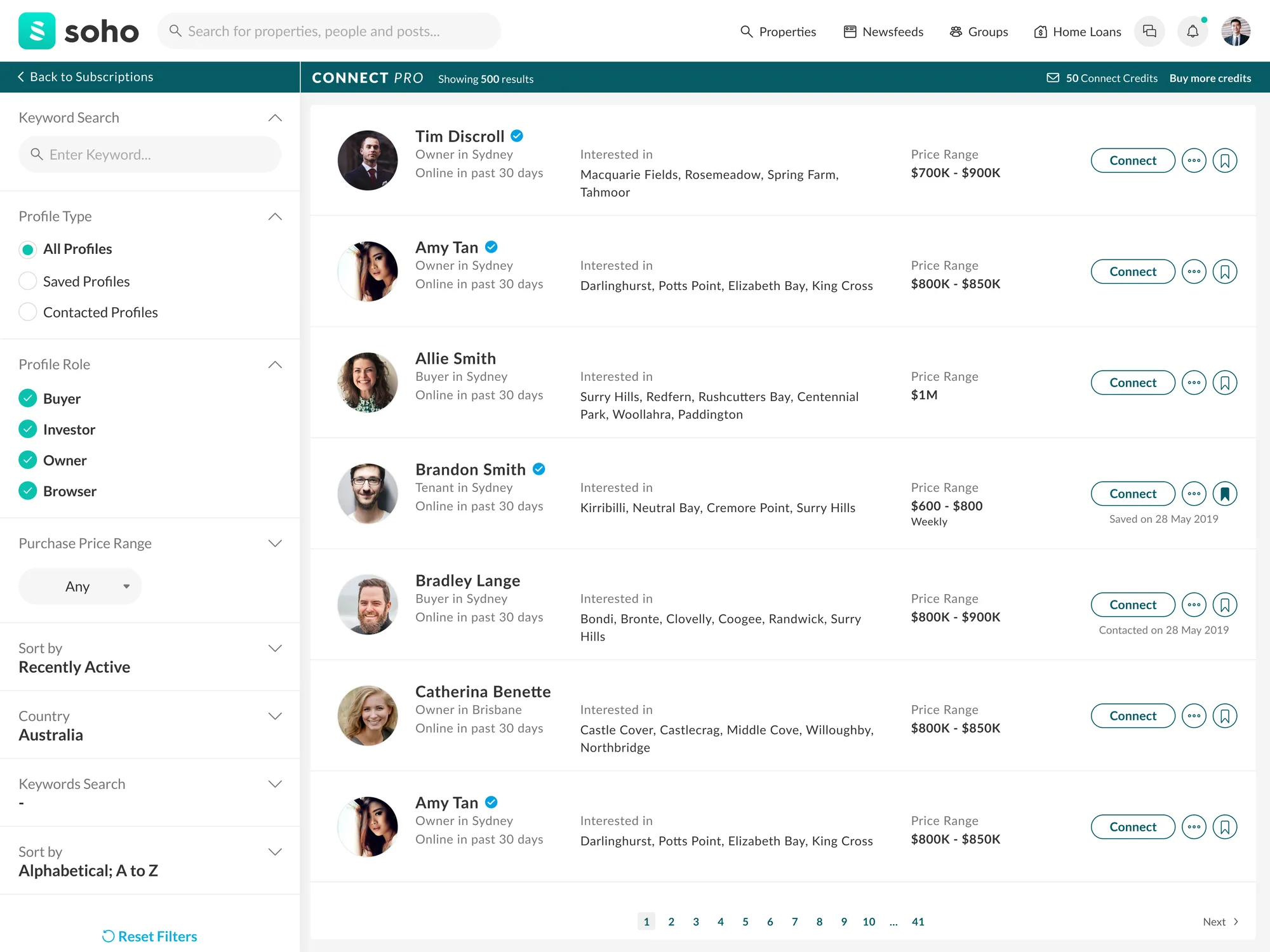
Connect Pro buyer discovery
Finding customers beyond incoming enquiries
Connect Pro allowed agents to proactively find potential customers based on their profiles, budgets and preferred locations, rather than relying solely on incoming enquiries.
Agent Portal and listing management, image 1 of 3
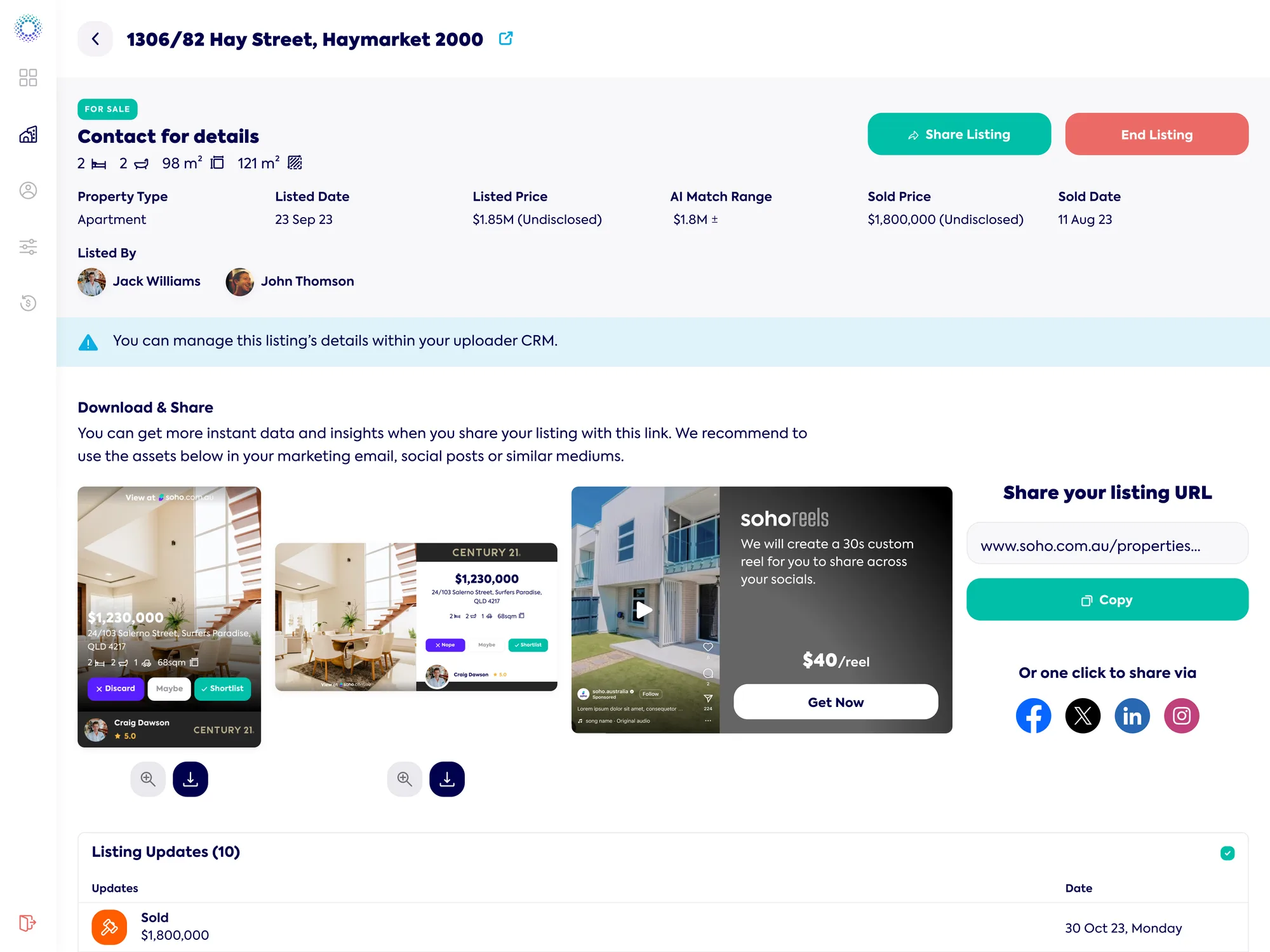
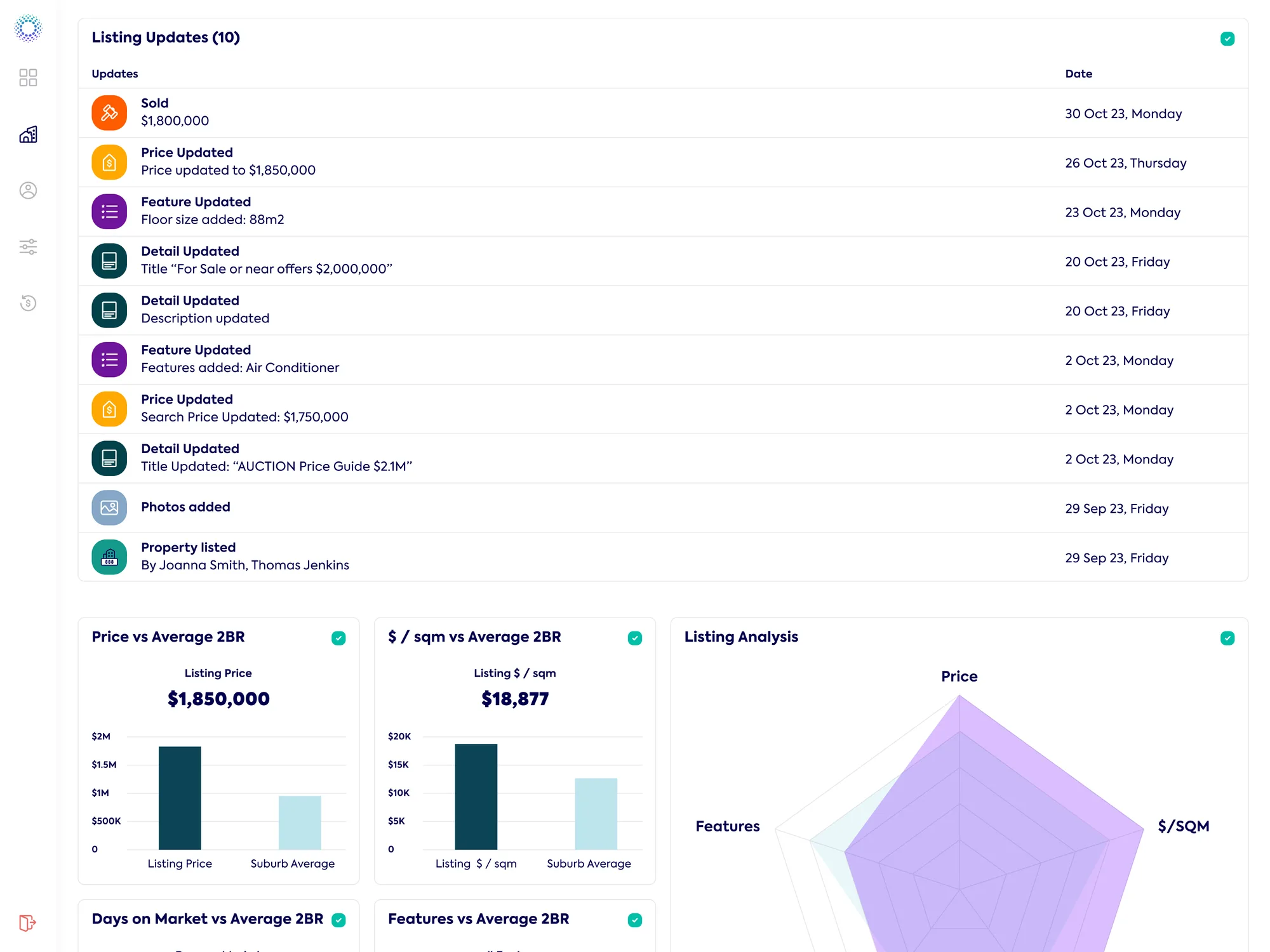
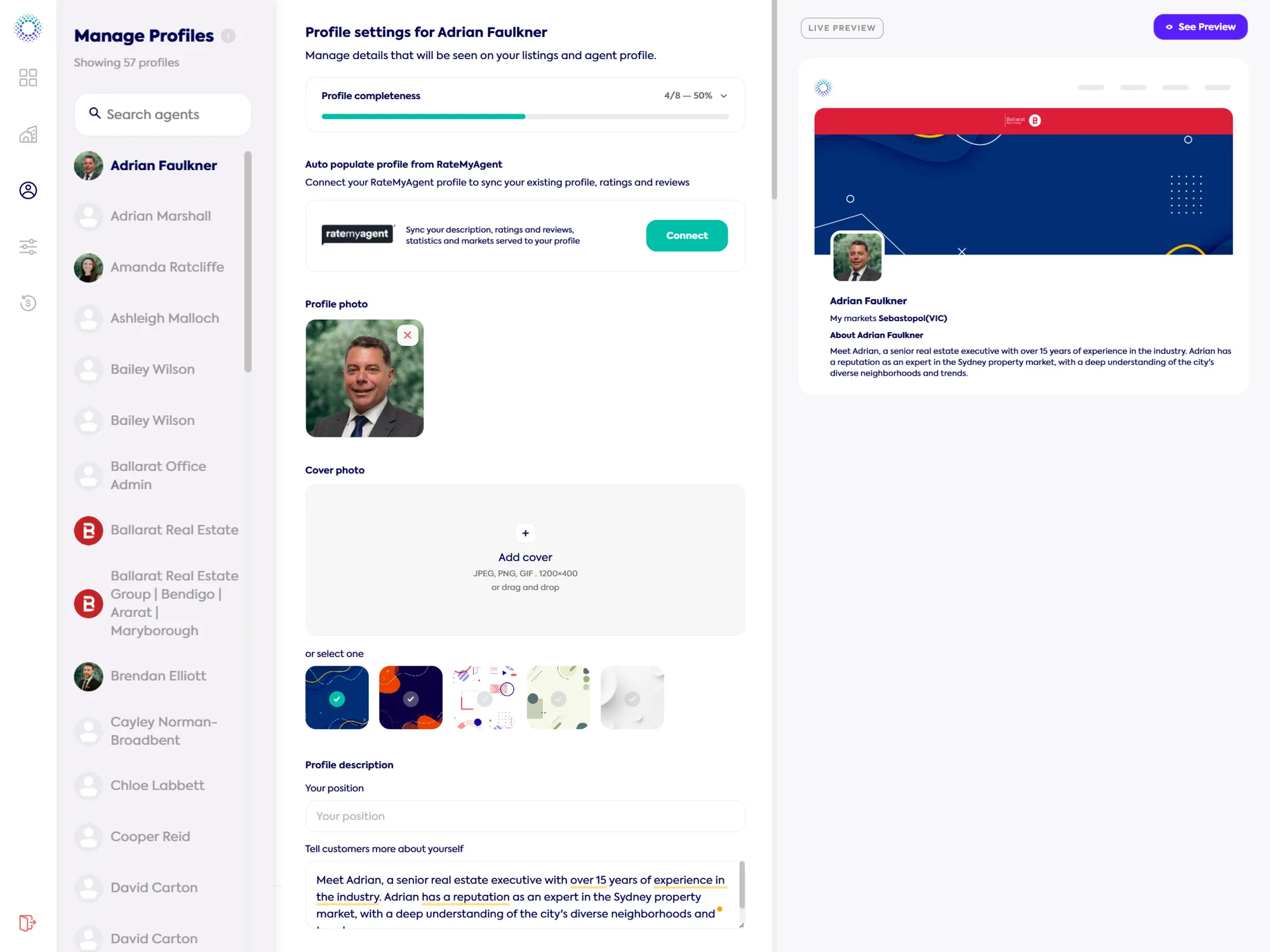
Agent Portal and listing management
Managing listings and online presence
The Agent Portal brought profiles, listings and marketing tools into one workspace, allowing agents to manage their online presence, track listing updates and share marketing assets.
ListingRadar, image 1 of 4
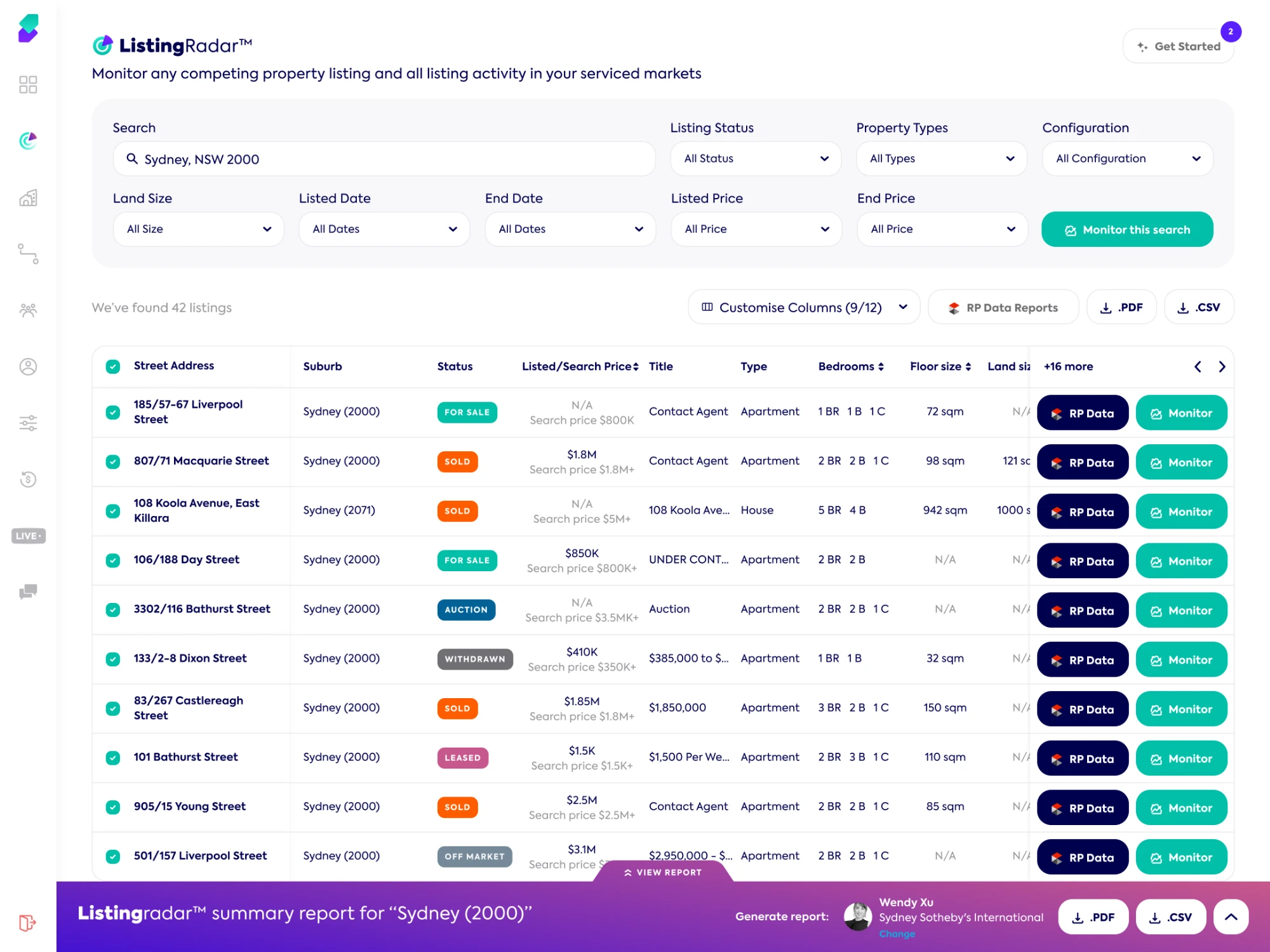
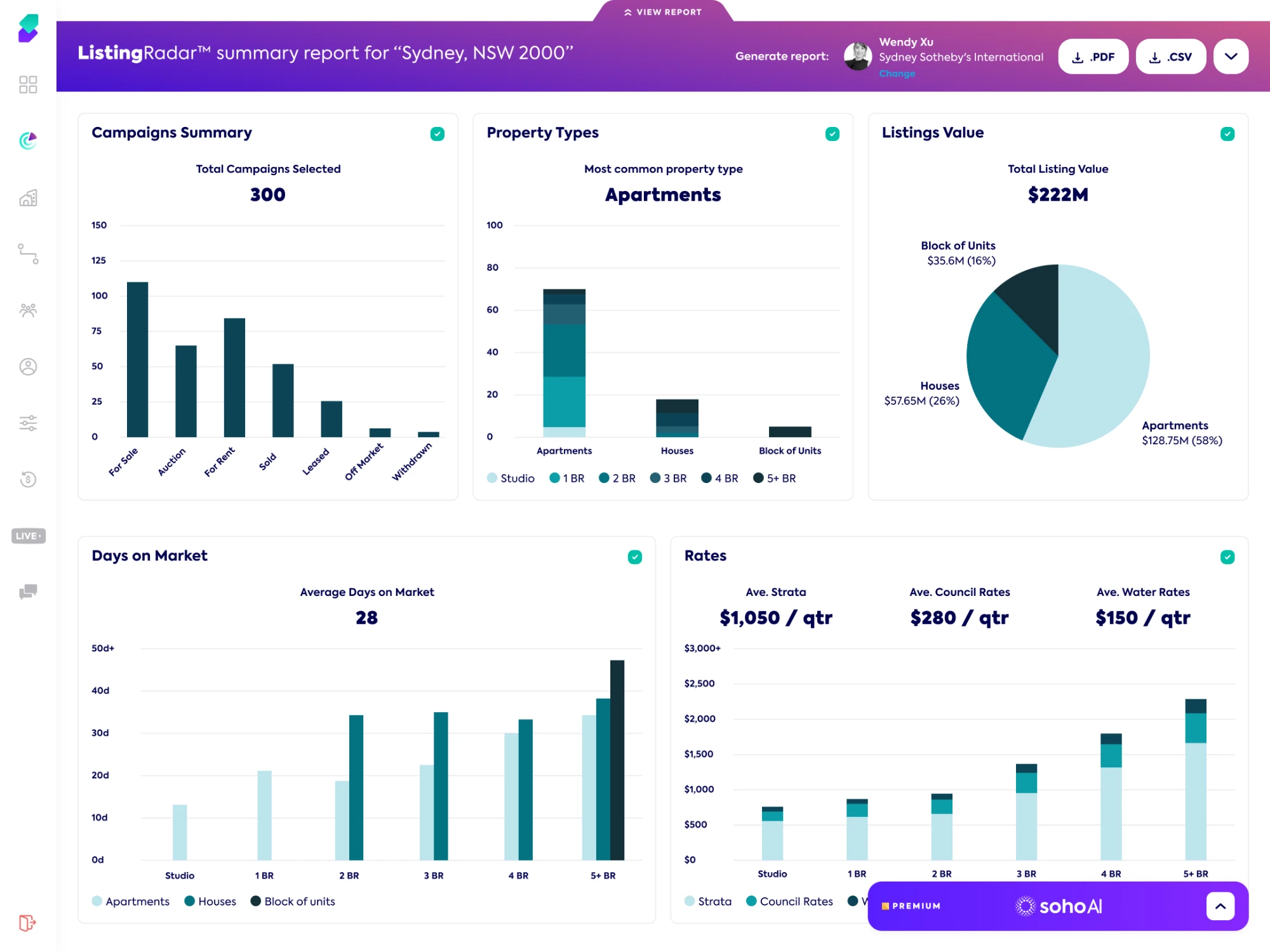
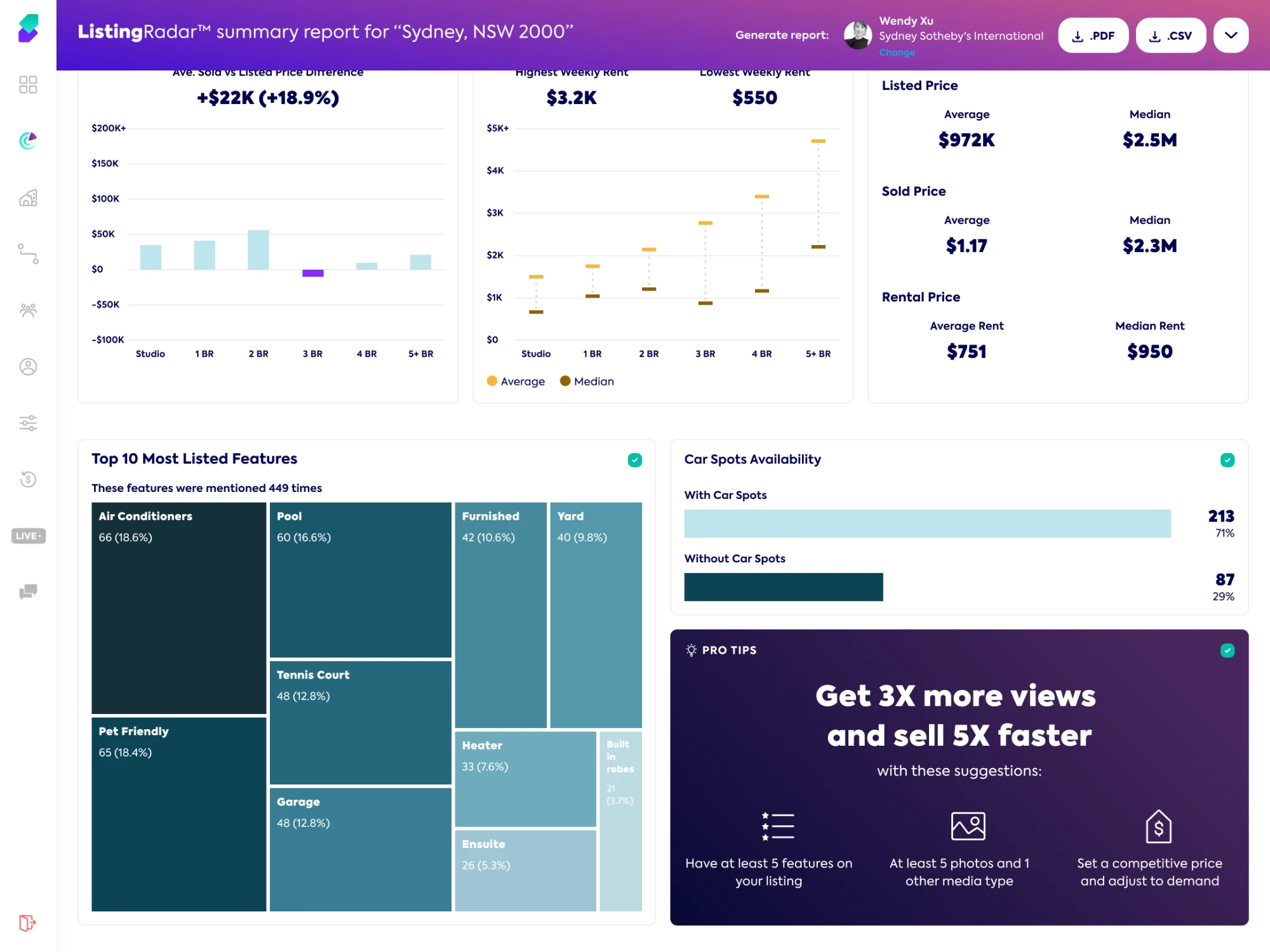
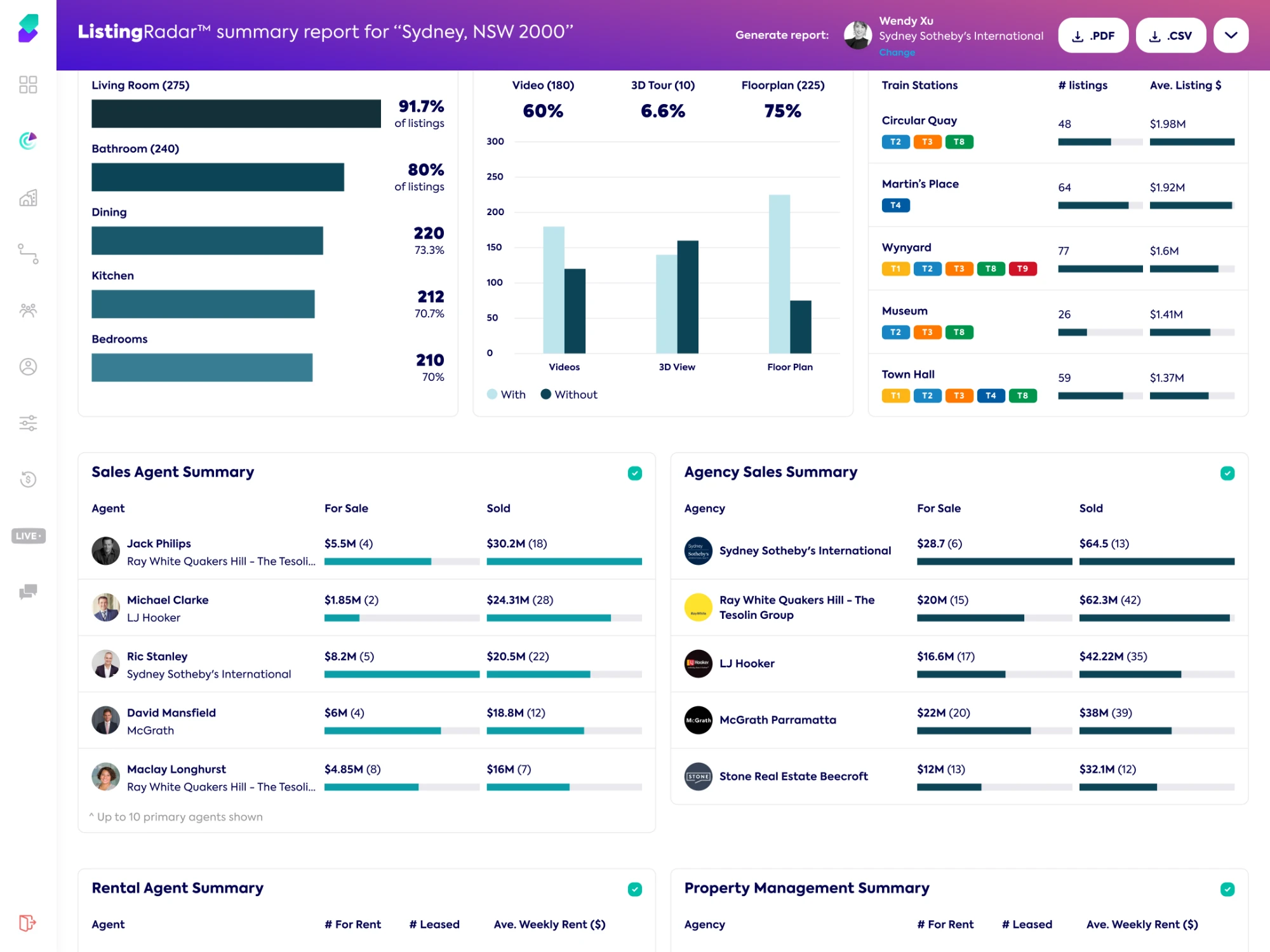
ListingRadar
Understanding the local market and competition
We explored using Soho's property data to track competing listings, pricing trends and agent performance, helping agents make more informed recommendations to their clients.
Listing Reports, image 1 of 2
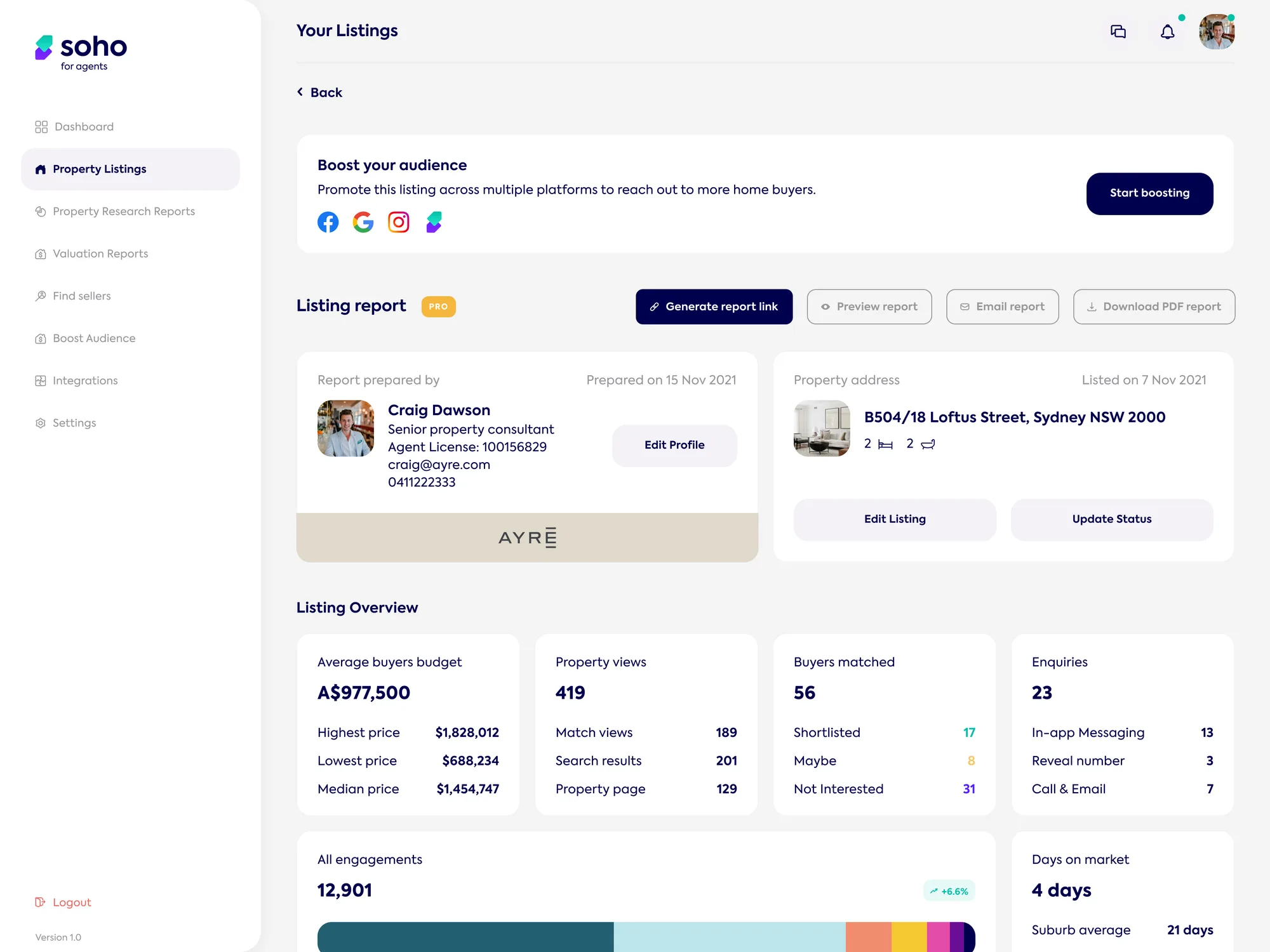
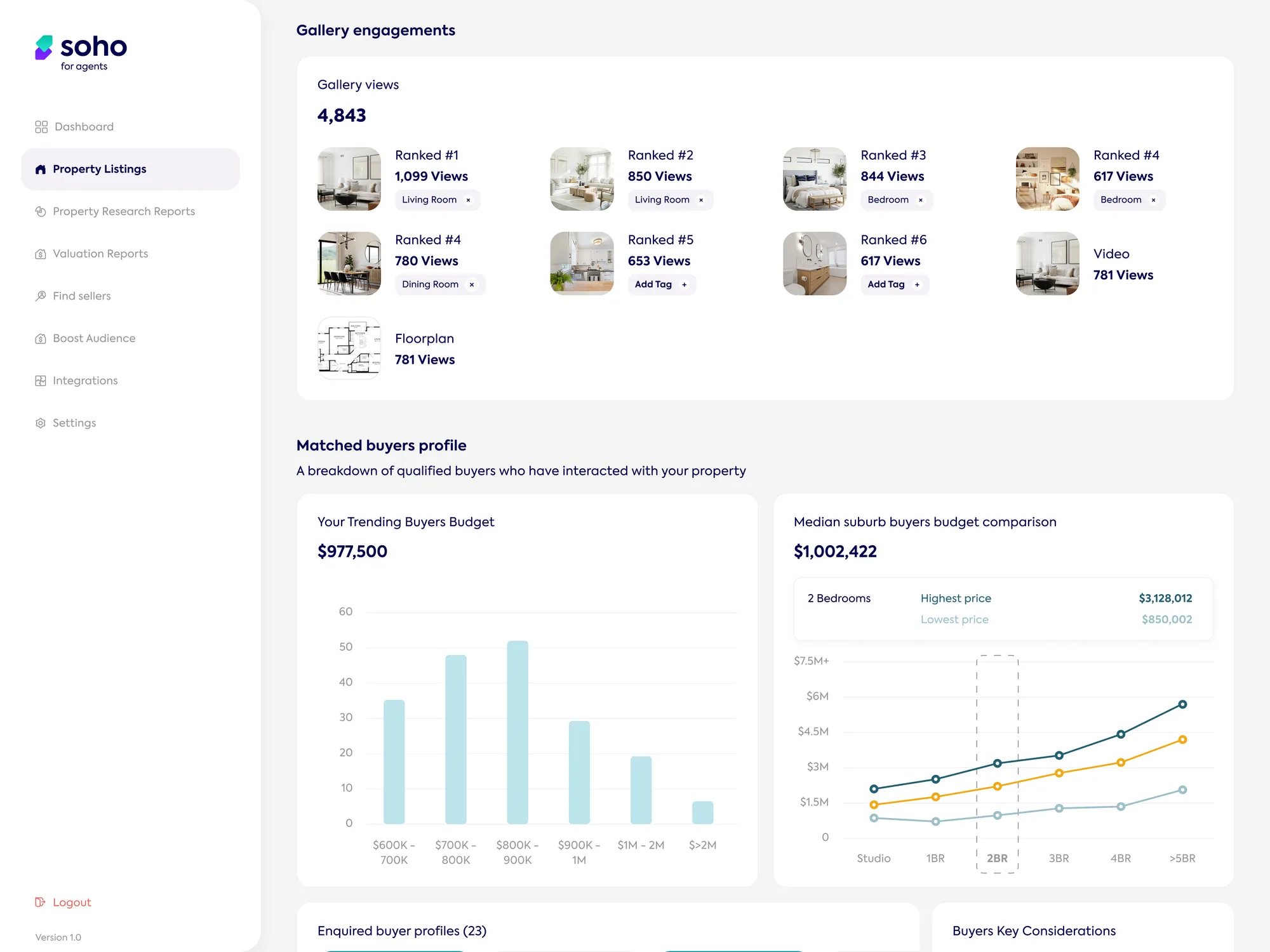
Listing Reports
Understanding buyer interest and listing performance
We explored insights beyond views and enquiries, including buyer interest, photo engagement and comparisons with the local market, helping agents make better listing and marketing decisions.
What came next
We also explored bringing property inspections online, allowing agents to reach buyers and renters who couldn’t attend in person. That idea became Soho Livecast.
Chapter 03 · Soho Livecast
Taking inspections online
Allowing agents to broadcast property inspections and auctions from their phones, while giving buyers and renters a way to experience properties remotely.

Context
Coming out of the COVID period, live streaming had become a familiar way for people to experience things remotely. Yet property inspections still largely depended on physical visits at fixed times, making them difficult to attend for people with busy schedules or those living interstate or overseas.
We saw an opportunity to make inspections more accessible while giving agents another way to reach potential customers.
Solution
We developed Soho Livecast, a dedicated mobile app that allowed agents to broadcast property inspections and auctions directly from their phones.
We designed the experience around agents whose listings were already connected to us through their CRM. By leveraging existing CRM connections, we avoided building a separate agent and listing verification process and could link each livestream directly to its property listing on Soho.
Agents could also feature their branding and stream simultaneously to Facebook and YouTube, while property seekers could watch directly from the listing page.
Our user research also revealed connectivity challenges in larger Australian homes, where moving between Wi-Fi access points could interrupt broadcasts. We designed a recovery experience that allowed agents to reconnect without restarting the stream, keeping viewers connected during temporary interruptions.
My contribution
I led the UX design of the broadcasting app and viewing experience across web and mobile, as well as the product branding, landing page and subscription journey.
Together with our mobile developer, we evaluated streaming technologies, developed the technical and API documentation and worked through the implementation requirements. I also worked on the pricing strategy, modelling streaming costs to shape our subscription plans.
Outcome
We launched Soho Livecast on iOS and Android, along with its landing page and subscription experience.
It was the first product I took end to end on my own: the research, the branding, the broadcasting app, the viewer experience and a subscription priced against what the streaming actually cost to run. Working through the streaming technology and API documentation alongside our mobile developer also changed how closely I worked with engineering on everything after it.
Livecast was eventually deprioritised as we shifted our focus towards SohoAI, the next major evolution of the platform.
Product in action
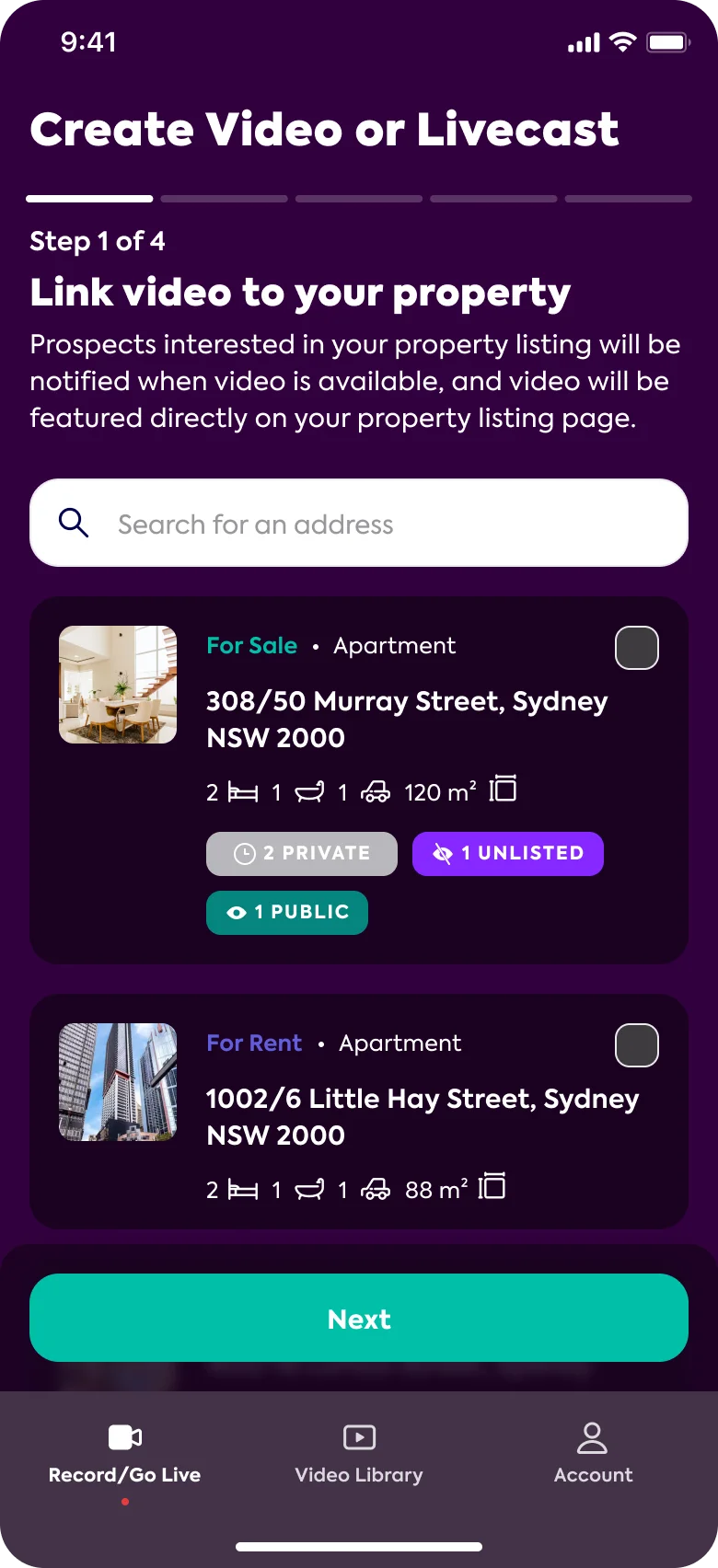
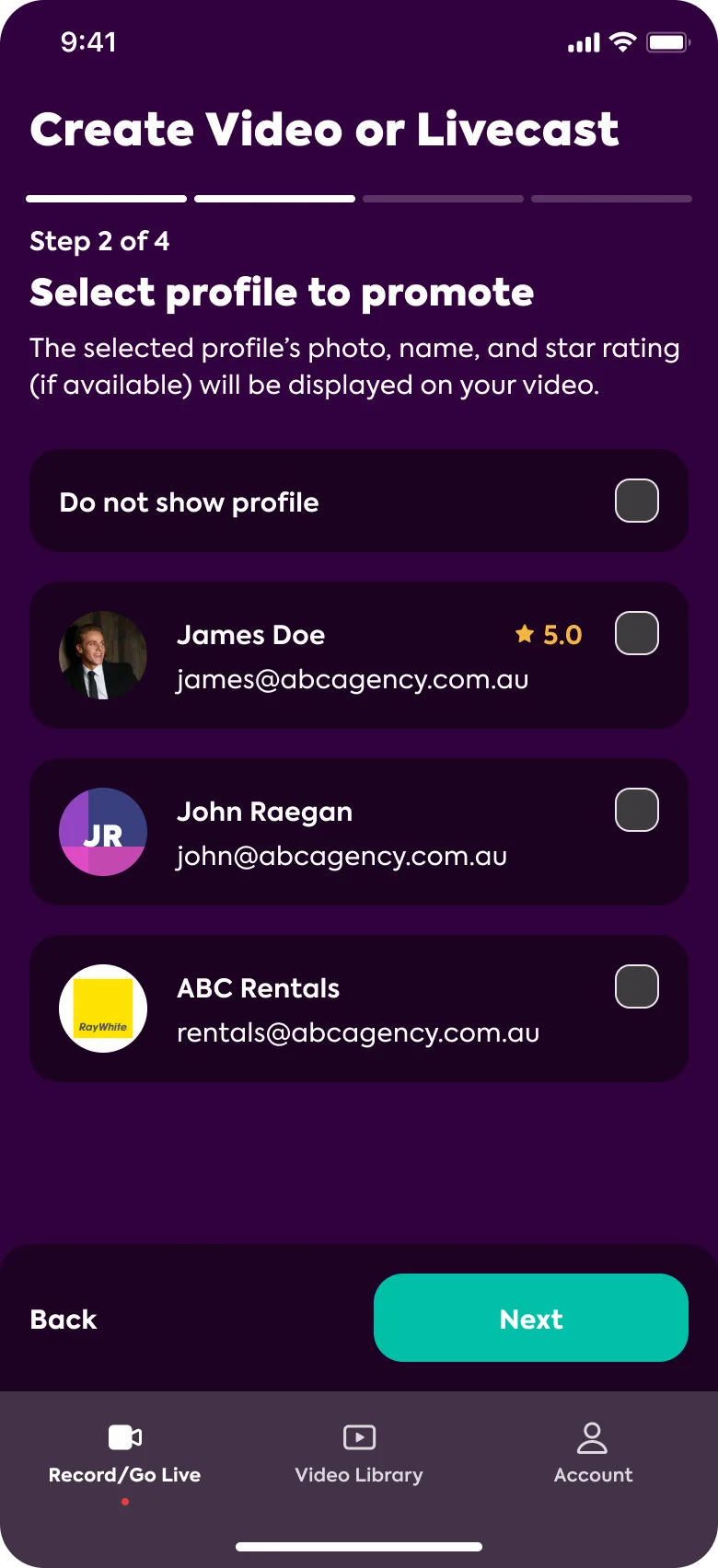
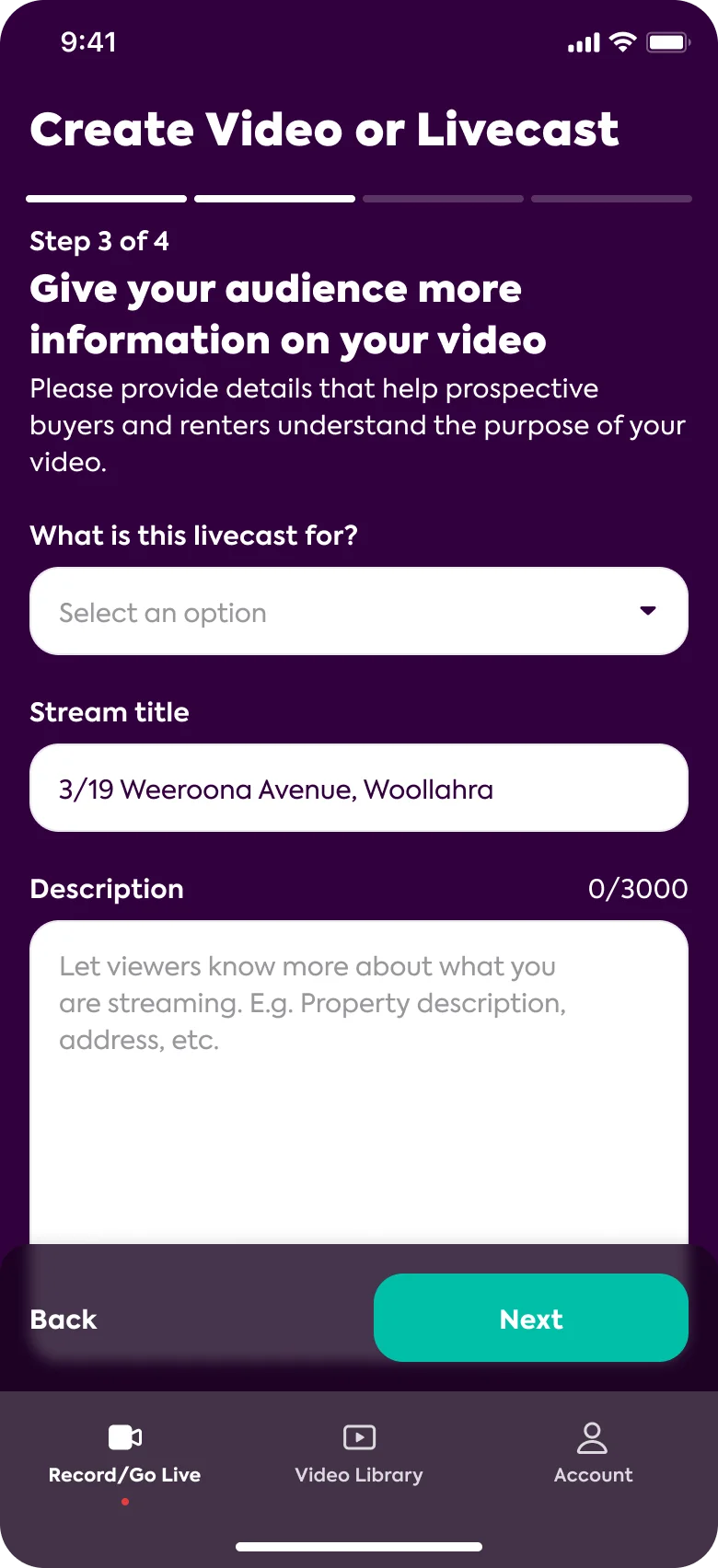
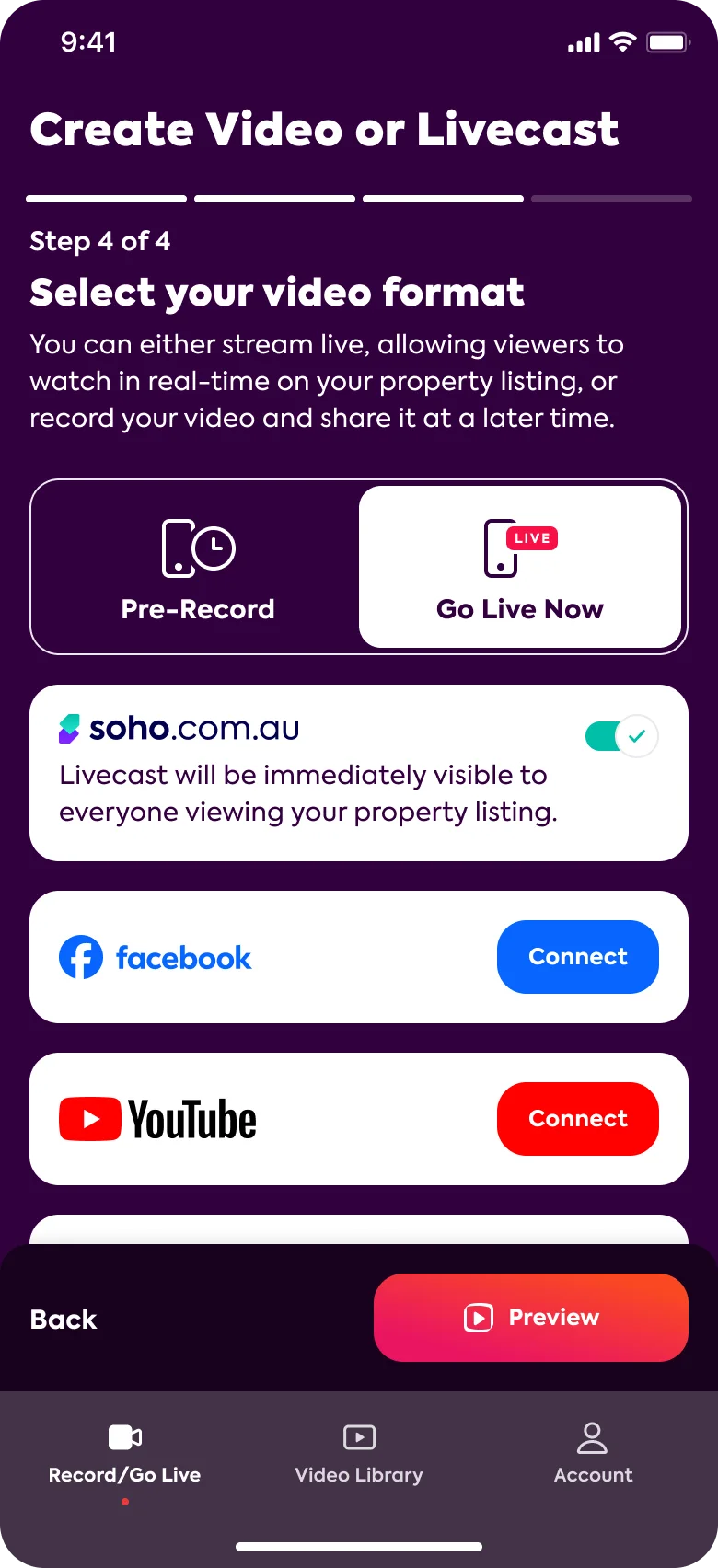
Designing the end-to-end broadcasting journey
From linking a property to configuring distribution channels and going live, we designed a guided experience that allowed agents to prepare and manage a broadcast from their phone.
Prepare the livestream
Link the broadcast to a property, select an agent profile and add details to give viewers context.
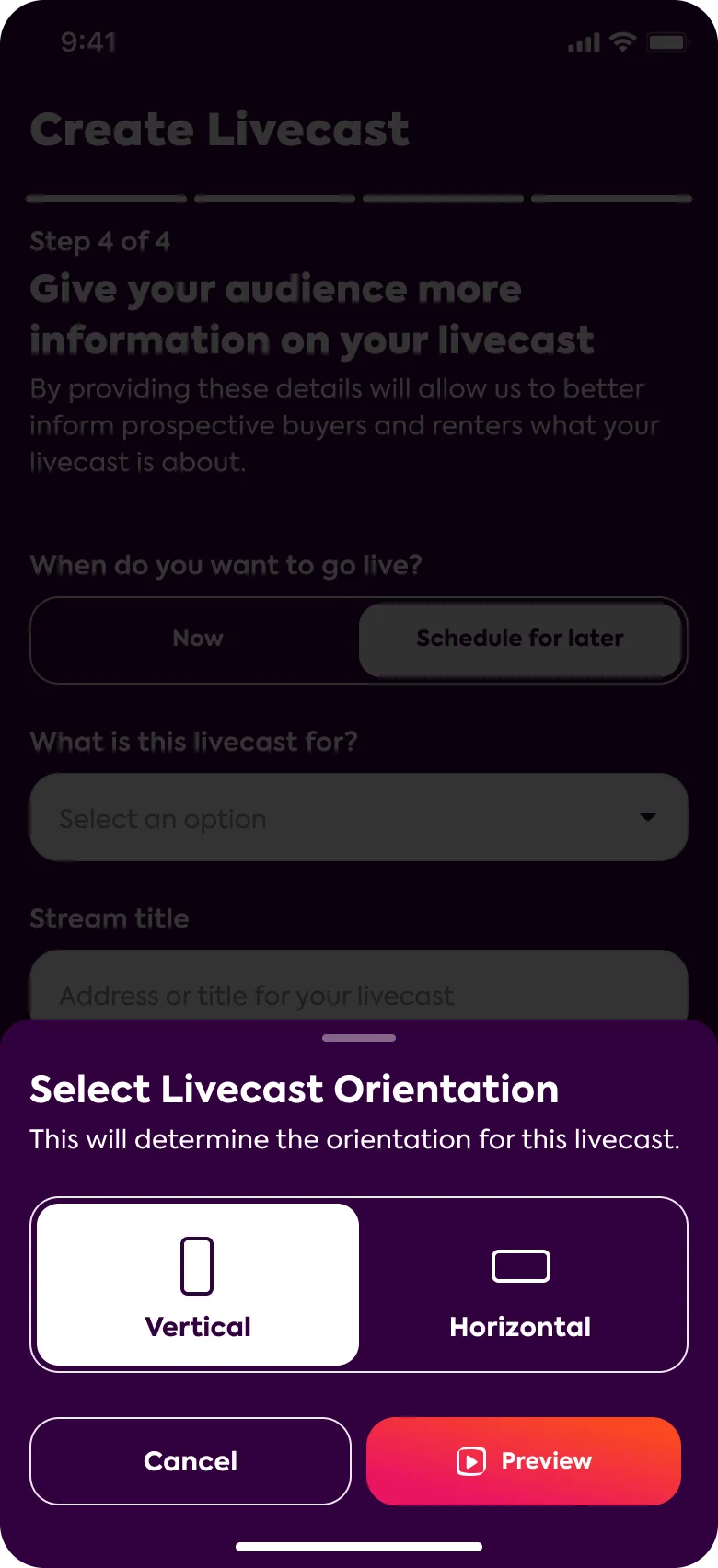
Configure the broadcast
Choose between live and pre-recorded video, select distribution channels and set the video orientation.
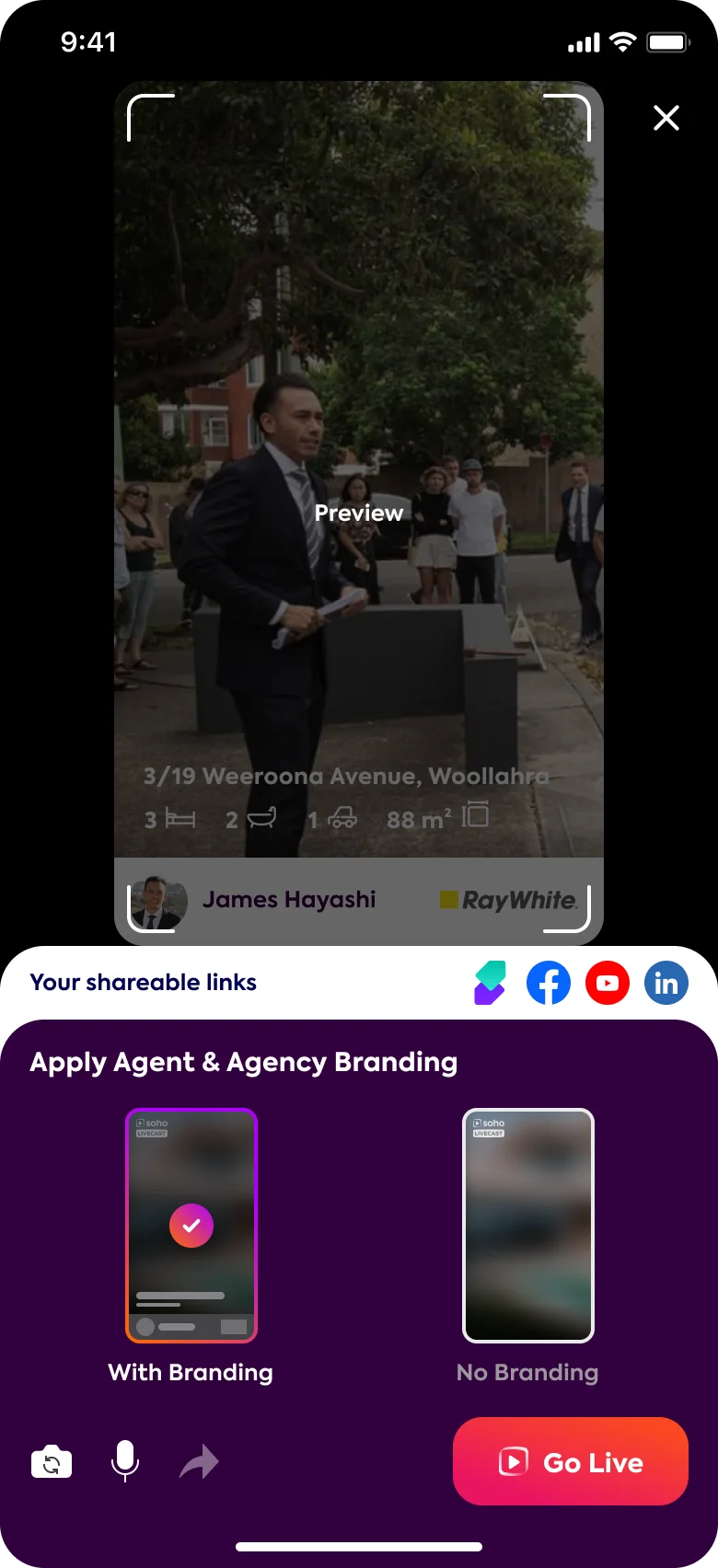
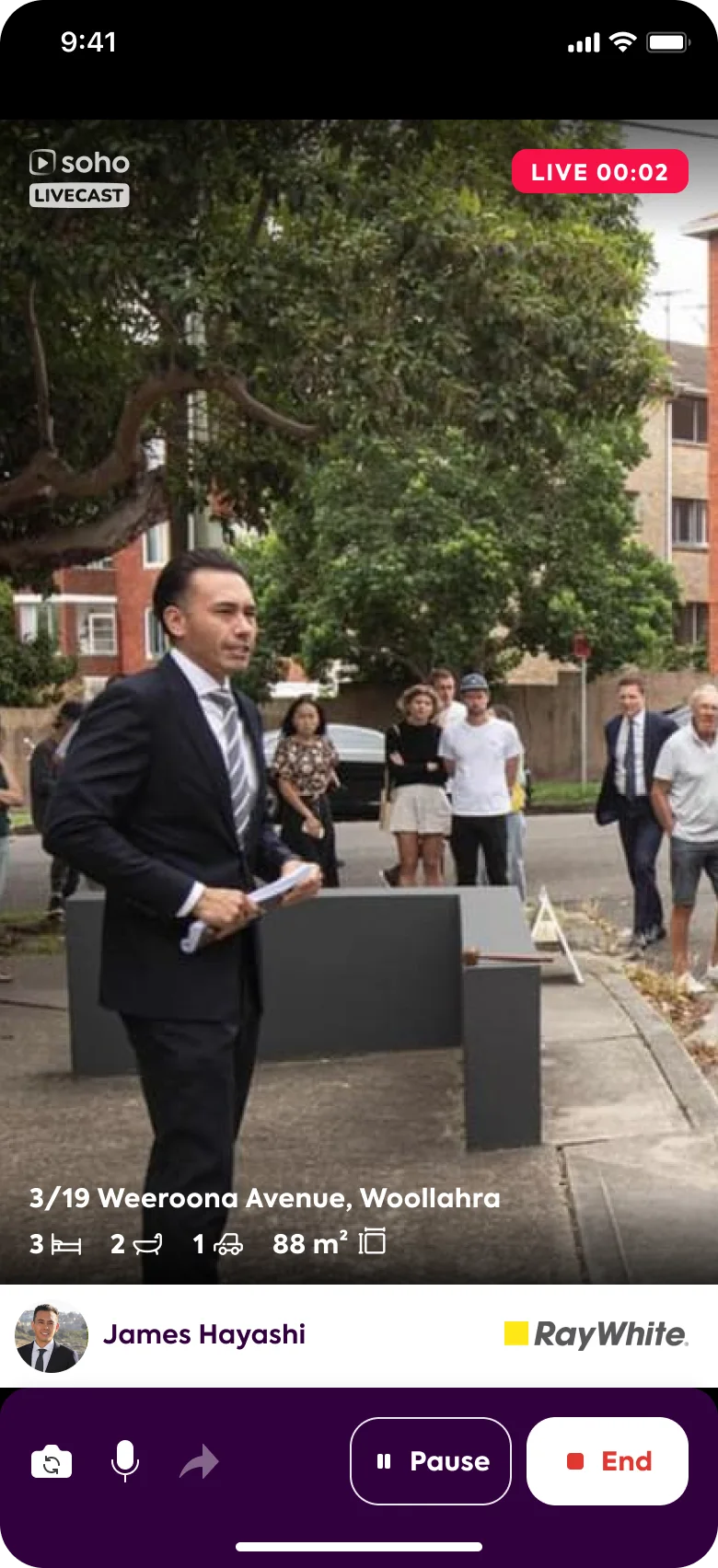
Preview and go live
Preview the broadcast, apply agent and agency branding and go live directly from the app.
What came next
We were constantly looking for ways to push Soho further and challenge how people traditionally discovered properties. With AI opening up new possibilities, we saw an opportunity to rethink the experience once again.
Chapter 04 · SohoAI
Asking for a home in your own words
Taking property discovery beyond filters and swipes, allowing property seekers and industry professionals to explore listings, market insights and data through natural conversations.
Context
Finding useful property information often meant searching across multiple websites, sometimes behind subscriptions or paywalls. At the other extreme, property portals could overwhelm users with charts and statistics they weren’t necessarily looking for.
General-purpose AI assistants made it easier to ask questions, but didn’t always have access to accurate, up-to-date property data.
Much like PropertyMatch, we saw an opportunity to differentiate Soho from established industry leaders. By combining emerging AI technology with our existing property data, we could move quickly to create a unique experience that made property information more accessible and relevant.
Solution
We developed SohoAI, a conversational real estate assistant for both property seekers and industry professionals.
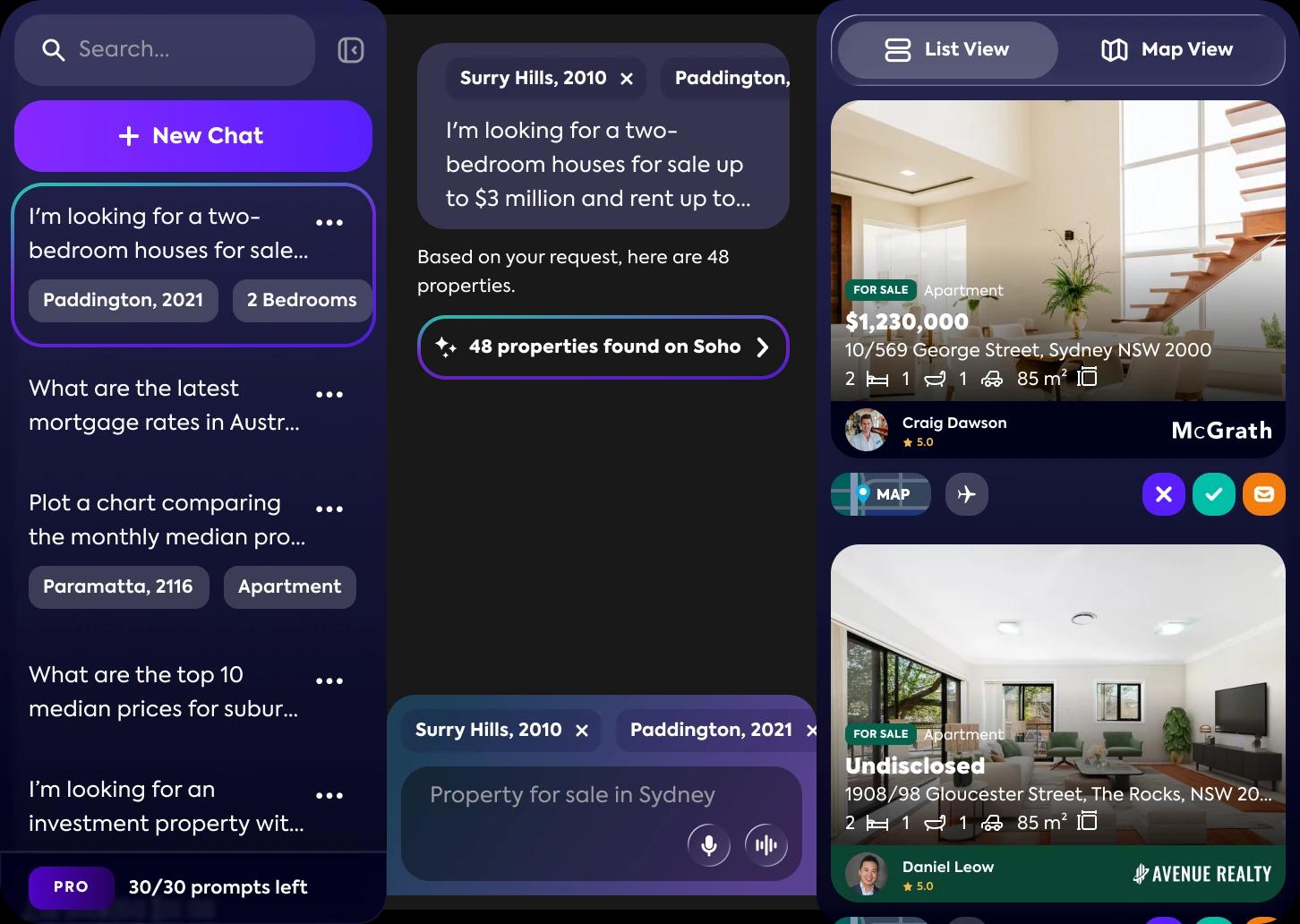
Users could ask everyday questions like “What should I budget for a three-bedroom apartment in Sydney?” or explore market insights such as median property prices, auction results and top-performing agents and agencies.
Using Soho’s property data, we designed responses around each question, presenting information through property and agent cards, tables, charts and maps.
With so much information to present, we needed an interface that went beyond a traditional scrolling chat experience.
Typical chat interface
SohoAI’s multi-panel interface
Designing beyond a typical chat interface
A traditional chat interface places everything in one scrolling conversation, where useful results can quickly get buried. We designed SohoAI with multiple panels, allowing users to explore different types of information alongside their conversation without losing context.
Interaction hint: Scroll the conversation and drag the panel dividers to explore.
We also introduced voice input, chat history and saved properties to make the experience more flexible.
My contribution
I translated the CEO’s AI vision into product requirements, led the UX design of the conversational experience and built the chat interface using AI-assisted coding tools.
Working closely with our engineering lead, who developed the underlying AI architecture, I contributed to product decisions, feature prioritisation, roadmaps and launch timelines.
Beyond the product experience, I designed the latest SohoAI logo and built our design system using Figma and Cursor to create reusable coded components. I also built a launch video library and motion effects library to showcase the product’s capabilities and establish a consistent animation style.
Outcome
SohoAI launched as a web beta and eventually became the main experience on the platform, alongside traditional search and PropertyMatch.
The transition also marked a new chapter for the company as we rebranded from Soho to SohoAI. I designed the new logo to reflect this evolution.
Today, SohoAI remains live, helping property seekers and industry professionals explore property listings and market information through natural conversations.
The evolution of Soho’s identity
- 2017


Original identity
- 2018


Designed by UDKU
- 2021


Designed by Raw.studio
- 2024


Designed by me
Product in action
Experience SohoAI
From discovering homes to exploring market insights, see how SohoAI turns everyday questions into useful answers.
Try SohoAIFind homes by simply asking
Describe what you’re looking for and discover relevant property listings without relying on traditional search filters.
Try SohoAITurn property data into insights
Ask questions about rental yields and market performance, with answers presented through tables and charts.
Try SohoAIMy role
Beyond product design
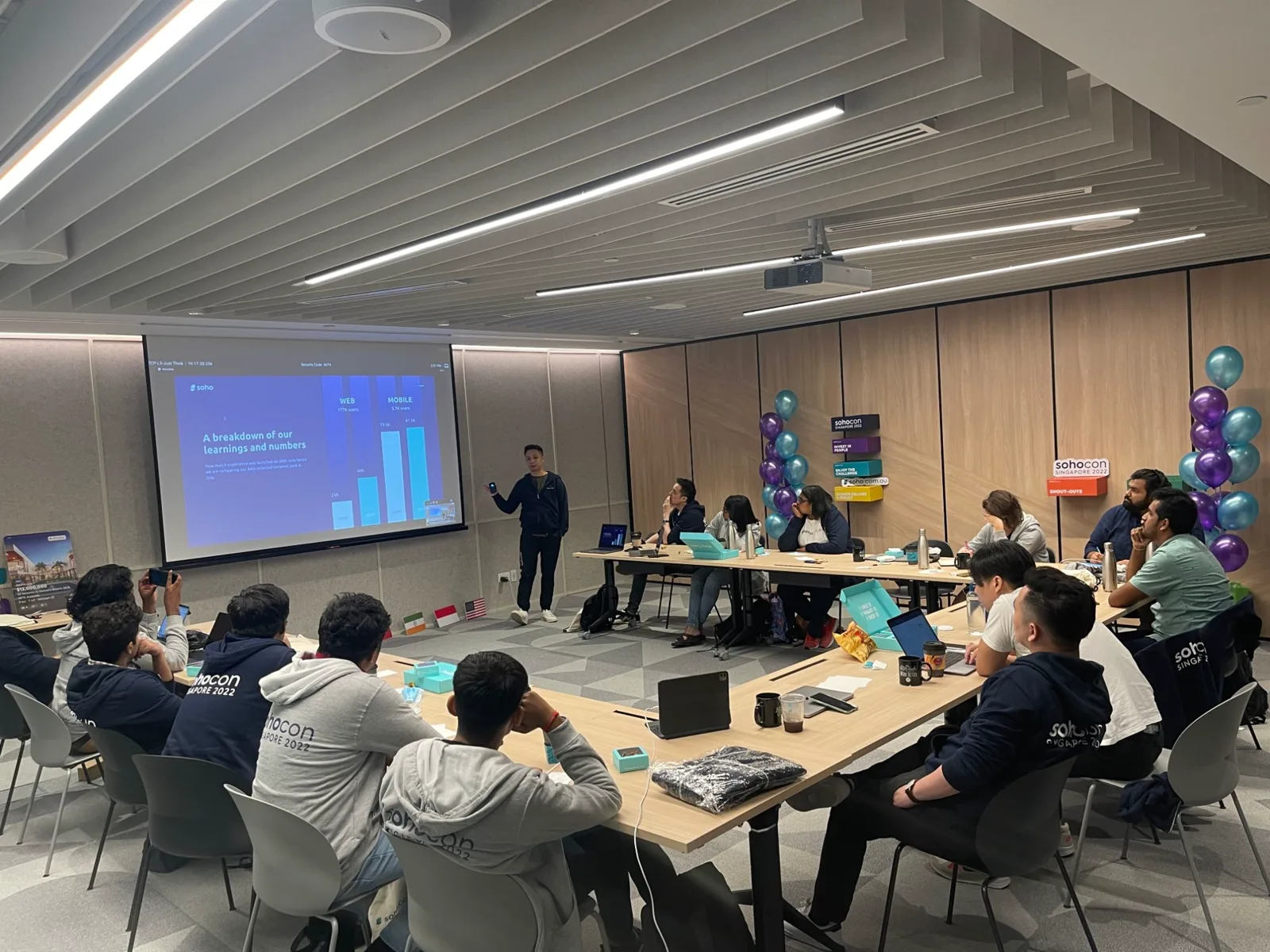
I joined Soho as a founding Product Designer and eventually became Head of Product. My responsibilities grew to include product strategy, team leadership and product launches, while I remained hands-on with design and development.
Life at Soho, image 1 of 4


Product strategy
Worked closely with the CEO on product direction, priorities, annual roadmaps and strategy reviews. I also helped prepare investor presentations and product metrics for three capital raises totalling over A$5M.
Team leadership
Managed four frontend and mobile developers, working closely with them to resolve challenges, provide guidance and conduct project retrospectives. I helped the team stay focused on priorities and timelines while maintaining weekly releases across web, iOS and Android.
Hands-on design
Stayed involved across the entire design process, from user research, flows and prototyping to UX/UI, interaction design, branding, graphic design and marketing materials.
Design and development
Used AI-assisted coding tools to build interfaces, reusable design-system components, animations and product videos, working closely with engineering to bring designs into production.